राधाकृष्ण नेत्रालय आणि सुपरस्पेशालिटी आय हॉस्पिटल®
राधाकृष्ण नेत्रालय आणि सुपरस्पेशालिटी आय हॉस्पिटल®
राधाकृष्ण नेत्रालय आणि सुपरस्पेशालिटी आय हॉस्पिटल®
राधाकृष्ण नेत्रालय आणि सुपरस्पेशालिटी आय हॉस्पिटल®
राधाकृष्ण नेत्रालय आणि सुपरस्पेशालिटी आय हॉस्पिटल®
राधाकृष्ण नेत्रालय आणि सुपरस्पेशालिटी आय हॉस्पिटल®
राधाकृष्ण नेत्रालय आणि सुपरस्पेशालिटी आय हॉस्पिटल®
राधाकृष्ण नेत्रालय आणि सुपरस्पेशालिटी आय हॉस्पिटल®
राधाकृष्ण नेत्रालय आणि सुपरस्पेशालिटी आय हॉस्पिटल®
राधाकृष्ण नेत्रालय आणि सुपरस्पेशालिटी आय हॉस्पिटल®
राधाकृष्ण नेत्रालय आणि सुपरस्पेशालिटी आय हॉस्पिटल®
राधाकृष्ण नेत्रालय आणि सुपरस्पेशालिटी आय हॉस्पिटल®


Pediatric Eye Doctor in Thane West: Does Screen Time Cause Myopia in Kids?
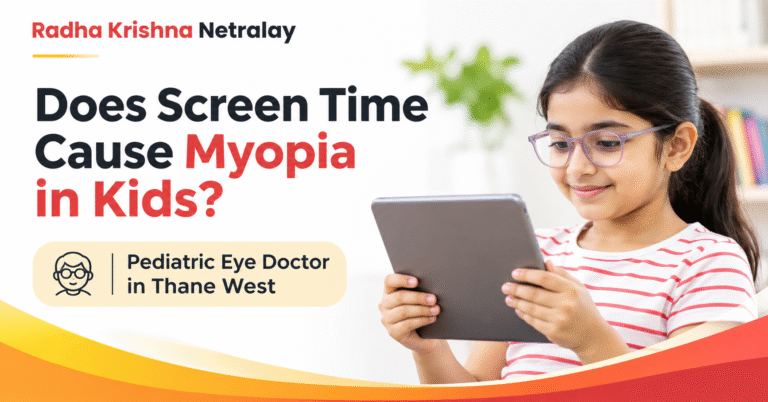
Screen time is linked to a higher risk of myopia (nearsightedness) in children, but research has not proven that screens alone cause it. The strongest evidence points to two things: long hours of close-up activity, which includes screens, books, and homework, and too little time outdoors. A pediatric eye doctor in Thane West can measure your child’s eyes accurately, track how fast their spectacle number is changing, and recommend ways to slow progression, such as outdoor time, healthier screen habits, and, where suitable, myopia control treatments.
If your child suddenly needs glasses, or their number goes up every few months, you may be asking whether online classes and mobile games are to blame. It is a fair question, and the honest answer is more nuanced than “screens are bad” or “screens are fine.” This guide explains what the evidence says, why myopia matters beyond the glasses, what actually helps, and when to see a children’s eye specialist.
What Is Myopia and Why Does It Matter?
Myopia is a condition in which the eye grows slightly too long, so distant objects look blurry while near objects stay clear, and it usually begins in childhood and tends to worsen through the teenage years. Children with myopia struggle to read the board at school, may squint, and often hold books or phones very close.
Myopia is more than a glasses problem. The longer the eye grows, the higher the long-term risk of serious conditions, including retinal detachment, myopic maculopathy, glaucoma, and early cataract. The American Academy of Ophthalmology explains that myopia is increasingly common worldwide and that higher degrees of myopia carry a greater risk of eye complications. This is why slowing progression matters, not just correcting vision with glasses.
Does Screen Time Cause Myopia?
Research shows an association between heavy screen use and myopia in children, but it does not prove that screens directly cause myopia, because screen time is closely tied to other factors such as long near-work hours and less time outdoors. Children who spend many hours on devices usually also spend fewer hours outside in daylight.
What we know with reasonable confidence:
- Myopia in children has risen sharply in many parts of the world, especially in urban areas
- Prolonged near work, such as reading, writing, and screens, is associated with greater risk
- Less outdoor time is consistently linked to higher myopia risk
- Studies during and after pandemic-era home schooling reported faster myopia onset and progression in many children
- Genetics matter: children with one or both myopic parents are at higher risk
What remains uncertain is whether the screen itself, the near distance, the long duration, or the lack of daylight is the main driver. For practical purposes, the safest approach is to reduce long, uninterrupted near work, increase outdoor time, and keep screen use balanced.
Why Outdoor Play Is the Best-Supported Protection
Of all the lifestyle factors studied, time outdoors has the strongest evidence for helping prevent myopia onset in children. Trials in schools, especially in Asia, found that adding daily outdoor time reduced the number of children who developed myopia.
Spending more time outdoors in daylight is associated with a lower risk of developing myopia, likely because bright natural light and distance viewing help regulate eye growth. It does not need to be formal exercise. Playing in the garden, walking to school, or cycling all count.
Practical ways to build it in:
- Aim for regular outdoor play every day, ideally around one to two hours in total, if possible
- Make it a family habit, such as an evening walk or weekend sports
- Schedule outdoor breaks between study sessions
- Encourage distance viewing, such as looking at trees and buildings, not just playing on a phone outdoors
Sun safety still matters. Use hats and avoid peak midday sun for long periods. The benefit is from daylight and distance viewing, not from sun exposure at harmful levels.
Online Classes, Mobile Use and Digital Eye Strain
Online classes and mobile devices have become part of childhood. Even if screens do not directly cause myopia, they can cause digital eye strain, which is uncomfortable and should not be ignored.
Signs of digital eye strain in children include:
- Rubbing or blinking the eyes frequently
- Complaints of tired, burning, or watery eyes
- Headaches after screen use
- Blurry vision that improves with rest
- Squinting or moving very close to the screen
- Irritability or losing focus during homework
Digital eye strain in children is temporary and usually improves with breaks, better posture and lighting, and correcting any underlying vision problem, but persistent symptoms deserve an eye examination. For a deeper look, see this guide to digital eye strain causes and prevention.
Healthy Screen Habits for Kids
- Follow the 20-20-20 rule. Every 20 minutes, look at something at least 20 feet away for 20 seconds.
- Keep a comfortable distance. Hold phones and tablets at a distance similar to a book, and place screens at arm’s length where possible.
- Use good lighting. Avoid reading or watching in a dark room, and avoid glare on the screen.
- Set limits by age. The World Health Organization recommends no sedentary screen time for infants and no more than one hour a day for children aged two to four, and encourages active play instead.
- Prefer larger screens for schoolwork. Phones encourage very close viewing.
- Avoid screens before bedtime, since they can disrupt sleep.
- Balance study with movement. Take short active breaks between lessons.
Warning Signs Your Child May Have Myopia
Children rarely say “my vision is blurry.” Many do not know what normal vision looks like. Watch for:
- Sitting very close to the television or holding books near the face
- Squinting to see the board or distant signs
- Frequent headaches or eye rubbing
- Poor school performance or lack of interest in reading
- Closing one eye or tilting the head to see
- Difficulty recognizing people from a distance
If you notice these signs, book a children’s eye examination. Do not wait for a school screening, since it may miss early changes. Learn more in this guide to a pediatric eye doctor in Thane West.
What Happens at a Pediatric Eye Exam?
A pediatric eye examination is adapted to your child’s age and cooperation. It usually includes:
- Vision testing using age-appropriate charts, such as pictures or symbols for young children
- Checks of eye alignment and movement for squint or lazy eye
- Examination of the front and back of the eye
- Cycloplegic refraction, which uses special drops to relax the focusing muscle so the true prescription can be measured
- Additional measurements, such as axial length, in some clinics, to track eye growth over time
Cycloplegic refraction is important in children because their focusing muscles are strong and can hide or exaggerate nearsightedness, so dilating drops give a more accurate prescription than a test without them. The drops cause temporary blurred near vision and light sensitivity for several hours, so bring sunglasses and plan accordingly.
A good children’s eye doctor makes the visit comfortable, explains what is happening in simple terms, and answers parents’ questions without rushing. See this page on the best ophthalmologist for children in Thane for what to look for.
Spectacle Numbers: What They Mean and How Fast They Change
Your child’s glasses prescription shows the degree of myopia, written with a minus sign, such as -1.50. A larger minus number means stronger myopia.
Some key points:
- Myopia often progresses most quickly in the early school years
- A typical child with myopia may see their number increase every year until the late teens or early twenties
- Single-vision glasses correct vision but do not slow the eye’s growth
- Regular checkups, usually every six to twelve months for children with myopia, track progression
Skipping glasses, or wearing the wrong strength, does not make myopia go away. Correct glasses help your child see, learn, and play comfortably.
Myopia Control: Options to Slow Progression
Because every step of progression raises long-term risk, doctors may recommend myopia control, a set of approaches aimed at slowing eye growth. Options include:
- Outdoor time and behaviour changes, the foundation for all children
- Low-dose atropine eye drops, used at very low concentrations to slow myopia progression in selected children
- Specialized spectacle lenses, designed with features that aim to slow progression
- Orthokeratology (ortho-K), rigid lenses worn overnight that temporarily reshape the cornea
- Multifocal or specially designed soft contact lenses, for suitable older children
Low-dose atropine drops are among the better-studied options for slowing myopia progression in children, but they must be prescribed and monitored by an eye doctor, since effects, side effects, and suitability vary. Possible side effects include light sensitivity and mild near-vision blur, and progression can speed up again if drops are stopped suddenly without guidance.
Not every child needs or suits every option. Age, current prescription, rate of change, eye health, and family circumstances all matter. Newer approaches such as red-light therapy are being studied, and your doctor can explain whether the evidence and safety data are strong enough for your child. Do not start any treatment on your own or based on social media advice.
What Parents Can Do Today
A simple plan for families:
- Get an eye exam if your child has symptoms, a family history of myopia, or has never been checked.
- Increase daily outdoor time and make it routine.
- Reduce long uninterrupted near work, including screens and reading, with regular breaks.
- Set screen limits appropriate for your child’s age and keep devices out of bedrooms at night.
- Use the right glasses and update them when the number changes.
- Follow up regularly, so progression is tracked.
- Ask about myopia control if your child’s number is rising quickly or they have a strong family history.
For routine screening guidance, see the importance of regular eye exams.
Common Myths About Children’s Eyes and Screens
- “Screens will permanently damage my child’s eyes.” There is no evidence that screens cause permanent eye damage in children, but heavy use may contribute to myopia and causes temporary strain.
- “Glasses will make my child’s eyes weaker.” Glasses do not weaken eyes. They help your child see clearly.
- “Myopia is only a spectacle problem.” Higher myopia raises long-term eye health risks.
- “Eye exercises cure myopia.” There is no good evidence that exercises reverse or stop myopia.
- “If my child sees well, no check is needed.” Many eye conditions, including lazy eye, are not obvious without testing.
Frequently Asked Questions
Does screen time cause myopia in kids? Screen time is associated with a higher risk of myopia, but research has not proven that screens alone cause it. Long near-work hours and too little outdoor time appear to play key roles, so balancing both is sensible.
How much outdoor time do children need to reduce myopia risk? Studies suggest that more daily time outdoors lowers myopia risk, with around one to two hours often cited. Any increase is beneficial, and it can include play, sport, and walking.
At what age should my child’s eyes be checked? Children should have eye checks in infancy and early childhood, before starting school, and then regularly. Children with symptoms, family history, or glasses need more frequent exams, often every six to twelve months.
Are atropine drops safe for children? Low-dose atropine drops are used under medical supervision to slow myopia progression in selected children. They can cause side effects such as light sensitivity, so they should be prescribed and monitored by an eye doctor.
Can myopia be cured or reversed in children? No. Glasses and treatments correct vision or slow progression, but they do not reverse myopia. Early detection and management give the best chance of keeping the number lower over time.
Protect Your Child’s Vision Early
Screens are part of modern childhood, and you do not have to ban them to protect your child’s eyes. Balance them with daylight, movement, breaks, and regular eye exams, and talk to a children’s eye specialist early if your child’s vision is changing. The earlier myopia is found and managed, the better the chance of keeping future eye health risks lower.
To book a child-friendly eye examination, visit the pediatric eye doctor in Thane West page, check directions and reviews on Google Maps, and schedule your child’s appointment.
Contacts
- KALYAN : 1st Floor, Sai Suman Tower, Tisgaon Naka, Near Jari Mari Gate, Kalyan East - 421306
- +91 8169829194
- radhakrishnanetralaydigital@gmail.com
- THANE :1st Floor, Shri Ganesh Building, Dr. Hajirnis, beside Axis Bank, off Lal Bahadur Shastri Marg, Kolbad, Uthalsar, Thane West, Thane, Maharashtra 400601
- +91 8169829194
- radhakrishnanetralaydigital@gmail.com
Radhakrishna Netralay © 2025 All Right Reserved

WhatsApp us