राधाकृष्ण नेत्रालय आणि सुपरस्पेशालिटी आय हॉस्पिटल®
राधाकृष्ण नेत्रालय आणि सुपरस्पेशालिटी आय हॉस्पिटल®
राधाकृष्ण नेत्रालय आणि सुपरस्पेशालिटी आय हॉस्पिटल®
राधाकृष्ण नेत्रालय आणि सुपरस्पेशालिटी आय हॉस्पिटल®
राधाकृष्ण नेत्रालय आणि सुपरस्पेशालिटी आय हॉस्पिटल®
राधाकृष्ण नेत्रालय आणि सुपरस्पेशालिटी आय हॉस्पिटल®
राधाकृष्ण नेत्रालय आणि सुपरस्पेशालिटी आय हॉस्पिटल®
राधाकृष्ण नेत्रालय आणि सुपरस्पेशालिटी आय हॉस्पिटल®
राधाकृष्ण नेत्रालय आणि सुपरस्पेशालिटी आय हॉस्पिटल®
राधाकृष्ण नेत्रालय आणि सुपरस्पेशालिटी आय हॉस्पिटल®
राधाकृष्ण नेत्रालय आणि सुपरस्पेशालिटी आय हॉस्पिटल®
राधाकृष्ण नेत्रालय आणि सुपरस्पेशालिटी आय हॉस्पिटल®


Best Eye Hospital in Thane: Myths Patients Believe vs the Facts
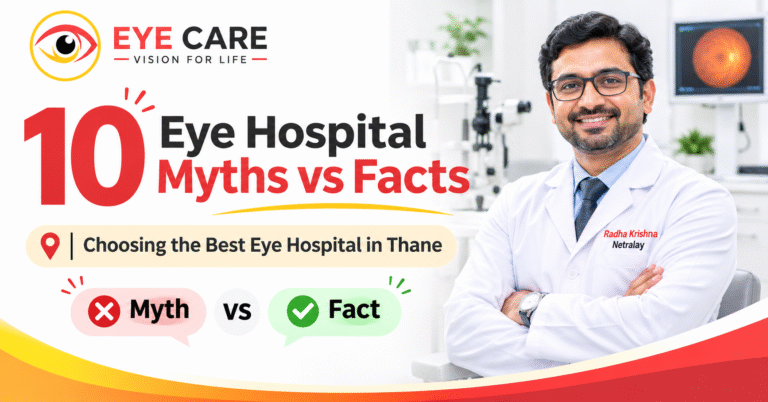
The best eye hospital in Thane is not the biggest, the most advertised, or the highest-rated on Google. It is the one with qualified ophthalmologists who personally examine you, a sterile operation theatre, the diagnostic equipment your condition needs, transparent billing, and honest outcomes. No official ranking exists to crown a single winner, so patients are better served by checking evidence than by trusting labels.
Choosing an eye hospital is harder than it looks, partly because so many beliefs about quality are repeated as fact. Some of them are partly true. Others are quietly costly. This guide takes ten common myths about picking a trusted eye care hospital in Thane West and replaces each with what actually matters, so you can decide with confidence.
Add Your Heading Text Here
Why Myths Shape Eye Hospital Choices
Patients rely on shortcuts such as brand size, star ratings, and price because eye care is difficult to judge from the outside, and these shortcuts often point in the wrong direction. Most people cannot tell whether a surgeon’s technique is good or whether an operation theatre follows proper protocols. So they judge what is visible: the lobby, the advertisements, the reviews, the quote.
The shortcuts are not worthless. Reviews and reputation carry real information. The problem is treating them as proof. A smarter approach is to use them as a starting point and then verify the things that actually predict safety and results. For a wider overview of local options, you can read this complete guide to eye hospitals in Thane.
Myth 1: The Biggest Hospital Is the Best Eye Hospital
Fact: Size does not determine eye care quality, because ophthalmology depends on specialist skill, focused equipment, and clean processes rather than on how large a hospital is. A large general hospital may treat eyes as a small department. A dedicated eye hospital often has more volume, more specialized staff, and equipment chosen for eye care.
That does not mean small is always better. A tiny clinic may lack an operation theatre or advanced imaging. The point is to judge the eye department itself: its doctors, its tests, and its surgical setup, not the building around it.
Ask these questions instead:
- Is there a dedicated ophthalmology team, or is eye care a side service?
- Which subspecialists are available?
- What is done on-site and what is referred elsewhere?
If you are weighing a Thane eye clinic against a larger Mumbai institution, this comparison of an eye clinic in Thane versus Mumbai hospitals explains how to think about travel, cost, and care continuity.
Myth 2: The Highest Google Rating Means the Best Hospital
Fact: A high rating is a useful signal but not proof of clinical quality, since reviews usually reflect service, politeness, and waiting time rather than surgical skill or complication rates. A hospital can be pleasant and still have average outcomes. Another can be brusque and technically excellent.
Online reviews also have limits:
- A 5.0 rating from a handful of reviews tells you less than 4.6 from hundreds
- Old reviews may not reflect current staff or practices
- Reviews can be solicited, selective, or in rare cases fabricated
- Patients rarely know whether their result was clinically optimal
Read reviews the way an investigator would. Look for recent, detailed ones, notice patterns across several reviews, and pay attention to how the hospital responds to criticism. If you want to see how a local profile looks in practice, check this hospital on Google Maps and compare the review recency and detail with others, and see these notes on an eye clinic near me in Thane West with reviews.
Myth 3: Hospital Rankings Tell You Which One Is Best
Fact: There is no widely recognised official ranking of private eye hospitals in Thane, so “top 10” and “number one” lists are usually marketing, paid placements, or opinion rather than verified comparisons. Titles such as “best” and “top-rated” can be self-awarded or based on selective criteria.
Be cautious about:
- Lists that do not explain how hospitals were evaluated
- Awards from organizations you cannot verify
- Claims of being “number one” without supporting data
More meaningful quality signals include formal accreditation, such as NABH, published qualifications of doctors, and transparent outcome and complication data when a hospital chooses to share it. Even accreditation should be checked for current validity rather than assumed.
Myth 4: The Most Expensive Hospital Gives the Best Care
Fact: Price reflects many things, including location, branding, and lens or technology choices, so a higher bill does not automatically mean a safer operation or better vision. You may pay more for a premium lens or laser option that your eye does not actually need.
The reverse also holds. Price is not a reliable quality indicator in either direction. What you can evaluate is value: what is included, and whether each item is justified for your case.
Ask for an itemized estimate covering the consultation, tests, procedure, lens or implant, medicines, and follow-ups. If you are comparing costs specifically, see this guide to an affordable eye hospital in Thane for how to weigh price against inclusions.
Myth 5: Cheap Eye Surgery Must Be Unsafe
Fact: A lower price is not necessarily unsafe, because costs can differ due to lens type, overhead, and scale, but an unusually low quote deserves questions about what is included and what is omitted. Many safe, well-run hospitals offer affordable packages, especially for standard monofocal cataract surgery.
What matters is transparency. A reasonable low price comes with clear inclusions and honest explanations. A suspicious one tends to come with:
- Vague descriptions of what the package covers
- Hidden add-ons for medicines, follow-ups, or the lens
- Pressure to upgrade after you arrive
- No written estimate
The safest approach is to treat cost as one factor and use qualifications, protocols, and billing clarity as the others. Price alone cannot tell you whether care is safe.
Myth 6: The Newest Machine Guarantees the Best Result
Fact: Technology helps only when a skilled surgeon uses it for the right patient, because the surgeon’s judgment and technique usually influence results more than the equipment itself. A new device can add precision in some situations, but it does not replace training, experience, or good case selection.
This is especially relevant to procedures marketed with terms like “robotic,” “bladeless,” or “laser.” Some technologies have genuine advantages in selected cases. Others offer limited evidence of better outcomes for most patients while costing more. An honest surgeon will explain why a technology is recommended for your eye and what it adds. For an example of this kind of balanced explanation, read about robotic cataract surgery and the marketing around it.
Myth 7: Surgeon Experience Does Not Matter Because Cataract Surgery Is Routine
Fact: Cataract surgery is common and generally safe, but surgeon experience matters most in complex cases, such as dense cataracts, small pupils, previous eye surgery, or coexisting eye disease. Routine cases often go smoothly with any competent surgeon. Unusual cases test planning, technique, and the ability to handle surprises.
Ask the surgeon:
- How many procedures like mine do you perform?
- What is your approach if complications arise?
- Will you personally perform my surgery?
- How do you track and review your own outcomes?
Experience also includes the quality of pre-operative evaluation. A careful surgeon measures, maps, and plans, instead of recommending surgery after a rushed look. If you need a surgeon for a challenging case, see how to evaluate the best cataract surgeon in Thane West.
Myth 8: If the Hospital Looks Clean, the Operation Theatre Must Be Sterile
Fact: A clean reception area says little about sterility in the operation theatre, since infection control depends on documented protocols, instrument sterilization, trained staff, and strict procedures that patients cannot see. The most important safety work happens out of view.
A sterile operation theatre in an eye hospital usually involves:
- Validated sterilization of surgical instruments
- Controlled access and appropriate air and surface hygiene
- Single-use items where appropriate
- Verification of patient identity, eye, and procedure before surgery
- Trained surgical and nursing staff following written protocols
You are allowed to ask about these. The World Health Organization treats patient safety as a global priority and supports patients asking questions about their care. A hospital that answers openly is usually one that takes safety seriously.
Myth 9: Transparent Billing Is Just a Nice-to-Have
Fact: Transparent billing is a marker of trustworthy care, because hospitals that itemize costs in advance usually run clearer processes and avoid surprises that can pressure patients mid-treatment. Unclear billing often signals disorganized systems or a sales-driven approach.
Transparent billing generally looks like:
- A written estimate before treatment
- An itemized bill listing each component
- Explanation of what might change the total
- Clear information on insurance, cashless, or payment options
- No pressure to decide immediately
If a hospital cannot explain its charges, treat that as a reason to pause, not just an inconvenience. Billing behavior often reflects how the hospital treats patients in general.
Myth 10: The Best Hospital Promises Perfect Results
Fact: No ethical eye hospital can guarantee perfect vision or zero risk, because every surgery carries some risk and outcomes depend on each patient’s eye, health, and healing. Claims of “100% success” or “no complications” should make you more cautious, not less.
Honest hospitals talk about probabilities, limits, and alternatives. They explain known risks, what is done if something goes wrong, and what you can do to improve your chances. They welcome a second opinion rather than discouraging it. The willingness to say “this may not be right for you” is often the strongest sign of integrity.
So What Actually Makes a Hospital Trustworthy?
Instead of searching for a “best” label, look for a combination of evidence-based indicators.
What to Check | Why It Matters | A Good Sign |
Doctor qualifications | Confirms training and scope | Named ophthalmologists with MS/DNB and subspecialty training |
Personal examination | Ensures proper evaluation | Doctor examines you, not only assistants |
Diagnostic equipment | Supports accurate diagnosis | On-site OCT, fundus imaging, tonometry |
Operation theatre and safety | Protects against infection | Documented sterilization and clear safety processes |
Billing transparency | Prevents surprises | Written, itemized estimates |
Follow-up care | Supports recovery | Scheduled reviews and an emergency contact |
Honest communication | Builds trust | Open about risks, alternatives, and second opinions |
You can also see how one hospital describes its approach in this page on why choose Radha Krishna Netralay, then compare the same factors across any hospital you are considering.
Frequently Asked Questions
How do I find the best eye hospital in Thane? Compare qualified doctors, on-site diagnostics, operation theatre standards, billing transparency, and recent patient feedback. Visiting for a consultation and asking direct questions usually tells you more than any ranking or advertisement.
Are online reviews reliable for choosing an eye hospital? They are helpful but limited. Reviews reflect service and experience more than clinical skill, so read recent, detailed ones, look for repeated patterns, and combine them with checks on qualifications and facilities.
Does a higher cost mean better eye surgery? Not necessarily. Cost can reflect lens choice, technology, and overhead rather than surgical quality. Ask for an itemized estimate and a clear reason for any premium option before deciding.
Is a second opinion worth it before eye surgery? Yes. A second opinion is common practice, especially for major procedures or complex conditions. A trustworthy hospital supports it, since it helps you make an informed decision.
What should I verify before surgery? Confirm who will operate on you, what the quoted price includes, which lens or technique will be used, how follow-up is handled, and who to contact if you have concerns after the procedure.
Choosing Based on Evidence
The best eye hospital in Thane is the one that holds up when you ask direct questions and check the answers. Set aside myths about size, ratings, price, and technology, and focus on qualified doctors, sterile processes, honest communication, and billing that you understand before treatment begins.
To see how that looks in practice, explore the best eye hospital in Thane West page, check directions and reviews on Google Maps, and book a consultation with your questions ready.
Contacts
- KALYAN : 1st Floor, Sai Suman Tower, Tisgaon Naka, Near Jari Mari Gate, Kalyan East - 421306
- +91 8169829194
- radhakrishnanetralaydigital@gmail.com
- THANE :1st Floor, Shri Ganesh Building, Dr. Hajirnis, beside Axis Bank, off Lal Bahadur Shastri Marg, Kolbad, Uthalsar, Thane West, Thane, Maharashtra 400601
- +91 8169829194
- radhakrishnanetralaydigital@gmail.com
Radhakrishna Netralay © 2025 All Right Reserved

WhatsApp us