राधाकृष्ण नेत्रालय आणि सुपरस्पेशालिटी आय हॉस्पिटल®
राधाकृष्ण नेत्रालय आणि सुपरस्पेशालिटी आय हॉस्पिटल®
राधाकृष्ण नेत्रालय आणि सुपरस्पेशालिटी आय हॉस्पिटल®
राधाकृष्ण नेत्रालय आणि सुपरस्पेशालिटी आय हॉस्पिटल®
राधाकृष्ण नेत्रालय आणि सुपरस्पेशालिटी आय हॉस्पिटल®
राधाकृष्ण नेत्रालय आणि सुपरस्पेशालिटी आय हॉस्पिटल®
राधाकृष्ण नेत्रालय आणि सुपरस्पेशालिटी आय हॉस्पिटल®
राधाकृष्ण नेत्रालय आणि सुपरस्पेशालिटी आय हॉस्पिटल®
राधाकृष्ण नेत्रालय आणि सुपरस्पेशालिटी आय हॉस्पिटल®
राधाकृष्ण नेत्रालय आणि सुपरस्पेशालिटी आय हॉस्पिटल®
राधाकृष्ण नेत्रालय आणि सुपरस्पेशालिटी आय हॉस्पिटल®
राधाकृष्ण नेत्रालय आणि सुपरस्पेशालिटी आय हॉस्पिटल®


Introduction
Nearly 1 in 3 adults over 40 in India will develop a cataract, yet most people don’t know where to start when searching for an eye hospital in Thane that can actually treat it. Between confusing treatment names, unclear costs, and a long list of clinics claiming to be “the best,” choosing the right place for your eyes can feel overwhelming — especially when vision itself is at stake.
In this guide, you will discover how cataract, LASIK, and glaucoma are diagnosed and treated, what to expect during your visit, and how to choose an eye hospital in Thane you can trust — without the guesswork.
This guide draws on the clinical experience of the team at Radhakrishna Netralay & Superspeciality Eye Hospital, an NABH-accredited eye hospital in Thane serving the region for over a decade, led by ophthalmologists including Dr. Sanket Nirgude (MS, DNB, FCPS, FAICO – Ophthalmology) and Dr. Jyoti Ghindani.
What Does an Eye Hospital in Thane Actually Treat?
A modern eye hospital in Thane is no longer just a place for spectacle prescriptions. Today, comprehensive eye centres manage everything from routine vision checks to complex retinal surgery, all under specialists trained in specific sub-fields of ophthalmology.
An eye hospital is a specialised medical facility that diagnoses and treats conditions affecting the cornea, lens, retina, and optic nerve. It works through trained ophthalmologists using diagnostic tools like OCT and slit-lamp exams.
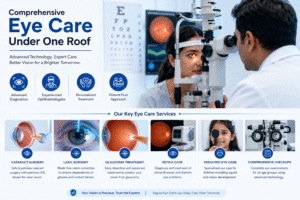
At a well-equipped eye clinic in Thane, you can typically expect:
● Comprehensive eye checkups and vision testing
● Cataract surgery (phacoemulsification)
● LASIK and other refractive procedures
● Glaucoma diagnosis and long-term management
● Retina evaluation and diabetic eye screening
● Pediatric eye care and squint correction
Why a Single-Roof Hospital Matters
Patients often need more than one specialist over a lifetime — a cataract consult in their 50s, glaucoma monitoring in their 60s. A hospital managing all sub-specialities avoids repeated referrals and lost medical history between clinics.
What Equipment Signals a Well-Equipped Eye Hospital in Thane
Look for Optical Coherence Tomography (OCT), corneal topography, and digital fundus photography
on-site. These tools let a doctor in Thane detect retinal and corneal changes long before symptoms
appear.
How Is Cataract Diagnosed and Treated?
Cataracts are one of the most common reasons people search for an ophthalmologist in Thane, particularly after age 50.
A cataract is a clouding of the eyes natural lens that blurs vision over time. It develops mainly due to ageing, though diabetes and prolonged UV exposure accelerate it. It’s most commonly treated with a short, outpatient surgery called phacoemulsification.
What Are the Early Signs of Cataracts?
● Blurry or hazy vision, especially at night
● Increased sensitivity to glare from headlights or sunlight
● Colours appearing faded or yellowed
● Frequent changes in spectacle power
What Happens During Cataract Surgery?
Modern cataract surgery uses phacoemulsification, where the clouded lens is broken up with ultrasound energy and replaced with an artificial intraocular lens (IOL). According to the American Academy of Ophthalmology, cataract surgery is one of the safest and most commonly performed surgical procedures worldwide. Most patients return to normal activity within a few days.
Is LASIK Eye Surgery Safe, and Who Is It For?
LASIK remains one of the most searched procedures at any eye hospital in Thane, mostly among patients aged 20–40 who are tired of glasses or contact lenses.
LASIK (Laser-Assisted In Situ Keratomileusis) is a refractive surgery that reshapes the cornea to correct vision. It works by using a laser to adjust how light focuses on the retina. It’s most commonly used to treat myopia, hypermetropia, and astigmatism.
Who Is a Good Candidate for LASIK?
Not everyone qualifies. Ophthalmologists typically evaluate stable spectacle power for at least one year, adequate corneal thickness, no active eye infections or severe dry eye, and age generally above 18–20 years.
Beyond Standard LASIK
Many eye hospitals, including Radhakrishna Netralay, now offer advanced options such as Contoura Vision and SMILE for patients seeking more precise, blade-free vision correction. These techniques are typically discussed during a detailed pre-LASIK evaluation
What Are the Early Signs of Glaucoma?
Glaucoma is often called the “silent thief of sight” because vision loss happens gradually, with no early warning pain.
Glaucoma is a group of eye conditions that damage the optic nerve, usually due to high intraocular pressure. It works by slowly reducing peripheral vision before central vision is affected. It’s most commonly managed with eye drops, laser treatment, or surgery to control eye pressure.
Common Warning Signs
● Gradual loss of side (peripheral) vision
● Difficulty adjusting to dim lighting
● Frequent headaches or eye pain in advanced cases
● Family history of glaucoma (a major risk factor)
Because symptoms appear late, the World Health Organization identifies glaucoma as one of the leading causes of irreversible blindness globally. Regular eye pressure checks after age 40 are the most reliable way to catch it early.
Can Diabetic Eye Disease Be Prevented?
For Thane’s growing population of diabetic patients, regular retina screening is one of the most overlooked forms of preventive eye care.
Diabetic eye disease occurs when high blood sugar damages retinal blood vessels over time. It works by weakening vessel walls, which can leak fluid or bleed into the retina. It’s most commonly prevented through annual diabetic eye screening and blood sugar control.
Why Annual Screening Matters Diabetic retinopathy often shows no symptoms until vision loss is already underway. OCT allows
specialists to detect microscopic retinal changes long before a patient notices blurred vision. Managing Risk Alongside Treatment
Coordinated care between an ophthalmologist and the patient’s physician — to manage blood sugar, blood pressure, and cholesterol — significantly reduces the risk of progression.
How Do I Choose the Right Eye Hospital in Thane?
With multiple eye clinics across Thane West, Ghodbunder Road, the decision often comes down to a few practical factors rather than marketing claims.
Choosing an eye hospital in Thane involves checking accreditation, doctor qualifications, and technology available on-site. It works best when the hospital offers coordinated care under one roof. It’s most useful to compare hospitals based on NABH accreditation, patient reviews, and range of sub-specialities.
Questions worth asking before booking a consultation:
1. Is the hospital NABH-accredited or empanelled with CGHS/insurance providers?
2. Do the ophthalmologists hold recognised qualifications (MS/DNB/FCPS in Ophthalmology)?
3. Are diagnostic tools like OCT and corneal topography available on-site?
4. Does the hospital manage multiple sub-specialities without referrals?
5. What do verified patient reviews say about outcomes and communication?
Why Thane Residents Choose a Nearby Eye Hospital
Travel time is one of the biggest reasons patients delay eye care. An eye hospital in Thane located within the neighbourhood — rather than a distant metro hospital — makes routine screening and post-surgery follow-ups realistic rather than an inconvenience.
Thane West (Kolbad, Uthalsar): easily reached from Ghodbunder Road, and surrounding residential pockets. Being close to home matters most after cataract or LASIK surgery, when patients need short, low-stress follow-up visits rather than a long commute across the city. It also means family members — parents needing cataract checks, children needing squint evaluation — can be treated at the same eye hospital in Thane instead of visiting separate clinics.
“Informed patients make better healthcare decisions and experience greater confidence during treatment.” — Dr. Jyoti Ghindani, Ophthalmologist, Radhakrishna Netralay & Superspeciality Eye Hospital, Thane.
At Radhakrishna Netralay’s Thane centre, consultations are conducted in Marathi, Hindi, and English to ensure patients fully understand their diagnosis before deciding on treatment — a small but often overlooked factor that affects whether patients follow through on early intervention. The hospital’s Thane West locations serve patients from Uthalsar, Khopat, Kausa, Mumbra, and Airoli, backed by over 102 verified Google reviews and a 4.7-star rating.
Frequently Asked Questions
1. What is the best eye hospital in Thane?
The best eye hospital in Thane is typically one that is NABH-accredited, staffed by qualified ophthalmologists, and equipped with on-site diagnostic tools like OCT. Radhakrishna Netralay meets these criteria across its Thane West centres.
2. How do I choose an eye hospital in Thane?
Check accreditation, doctor qualifications (MS/DNB/FCPS in Ophthalmology), on-site technology, range of sub-specialities offered, and verified patient reviews before booking a consultation.
3. When should I visit an eye specialist?
Visit an eye specialist if you notice blurry vision, glare sensitivity, frequent headaches, or a family history of glaucoma. Adults over 40 should also get annual checkups even without symptoms.
4. Is LASIK surgery safe?
LASIK is a well-established refractive procedure with a strong safety record when performed on suitable candidates after a thorough corneal evaluation, including corneal thickness and topography checks.
5. What are the early signs of glaucoma?
Early signs include gradual loss of peripheral vision, difficulty adjusting to dim light, and in some cases headaches or eye pain. Because symptomsmappear late, routine eye pressure checks are essential after age 40.
6. Can diabetic eye disease be prevented?
Diabetic eye disease can often be delayed or minimised through annual diabetic eye screening, blood sugar control, and coordinated care between an ophthalmologist and physician.
Conclusion:-
Choosing the right eye hospital in Thane comes down to three things: qualified specialists, access to modern diagnostic technology, and a hospital that manages your care under one roof rather than sending you elsewhere. Whether you're dealing with early cataract symptoms, considering LASIK, or need routine glaucoma monitoring, timely diagnosis remains the single biggest factor in protecting
your vision. An accessible eye hospital in Thane west — one you can actually get to for follow-ups — is what turns good intentions into consistent eye care. Regular checkups, not just treatment after symptoms appear, are what actually prevent long-term vision loss.
Book Your Eye Checkup Today
Book a comprehensive eye checkup at Radhakrishna Netralay & Superspeciality Eye Hospital, Thane West, today — consultations are available in Marathi, Hindi, and English.
Schedule Your Appointment →
Author Bio
Dr. Jyoti Ghindani is an Ophthalmologist with over 10 years of experience in comprehensive eye care at Radhakrishna Netralay & Superspeciality Eye Hospital, Thane and Kalyan. She has been part of a team that has treated 15,000+ patients across cataract, LASIK, glaucoma, and retina care. View full profile on our About Us page.
Contacts
- KALYAN : 1st Floor, Sai Suman Tower, Tisgaon Naka, Near Jari Mari Gate, Kalyan East - 421306
- +91 8169829194
- radhakrishnanetralaydigital@gmail.com
- THANE :1st Floor, Shri Ganesh Building, Dr. Hajirnis, beside Axis Bank, off Lal Bahadur Shastri Marg, Kolbad, Uthalsar, Thane West, Thane, Maharashtra 400601
- +91 8169829194
- radhakrishnanetralaydigital@gmail.com
Radhakrishna Netralay © 2025 All Right Reserved

WhatsApp us